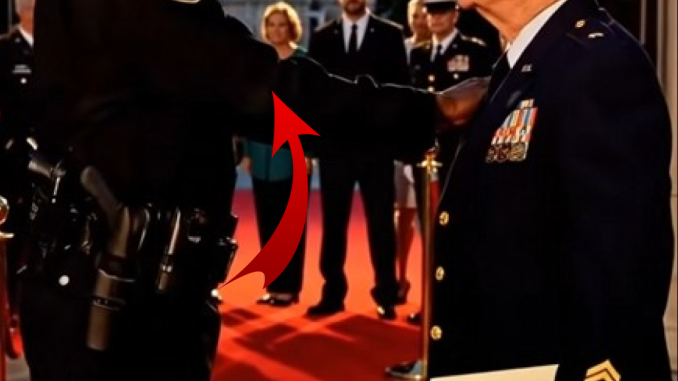
The entrance to the military ceremony was lined with red carpet, polished shoes, and formal uniforms. Guests arrived in tailored suits, exchanging greetings under soft evening lights. It was meant to be a night of honor, gratitude, and recognition.
Then an elderly man approached the gate.
He wore a simple, well-pressed suit. His shoes were clean but modest. A few medals rested quietly on his chest — not flashy, not exaggerated, just dignified. He carried himself with calm confidence, the kind that comes from experience rather than display.
Before he could take another step, a security guard extended his arm.
“Stop right there, sir. Invitation only.”
The elderly officer paused. His posture remained straight.
“I am invited,” he replied evenly.
The guard scanned him from head to toe, hesitation turning into assumption. “This ceremony is for honored guests. Please step aside.”
A few nearby attendees slowed their walk. Whispers began. The elderly officer did not raise his voice.
“That is exactly why I’m here.”
Instead of checking further, the guard signaled to a second security member. The tone shifted from routine procedure to public tension.
“Sir, if you don’t comply, we will escort you away.”
Phones quietly lifted in the background. The elderly officer’s face showed neither anger nor embarrassment — only restraint.
“You’re prepared to remove me,” he said firmly, “without verifying properly?”
“I’ve seen enough,” the guard answered.
For a moment, the air felt heavy. What was supposed to be a celebration was turning into a spectacle.
That’s when the event organizer hurried toward the scene, concern written across his face.
“What is happening here?”
The guard gestured toward the elderly officer. “He doesn’t have clearance.”
The organizer looked at the man — and immediately froze.
“You stopped him?” he asked, voice tightening.
“Yes, sir. He—”
“He is tonight’s honoree.”
Silence spread faster than the earlier whispers.
The same guests who had been quietly observing now stood still. The phones that had recorded tension were now capturing disbelief.
The elderly officer was not just invited. He was the reason everyone had gathered.
The guard’s posture shifted instantly. Authority turned into realization.
“…Sir, I apologize.”
The organizer remained composed but firm. “You attempted to remove the guest of honor without confirming his credentials. This will be reviewed.”
It wasn’t shouted. It wasn’t dramatic. But it was clear accountability.
The elderly officer looked at the guard for a long moment. There was no anger in his eyes — only a lesson waiting to be spoken.
“Respect should never depend on appearance,” he said calmly.
The words carried more weight than the medals on his chest.
The organizer personally escorted him inside. This time, no one blocked his path. Instead, applause began softly — then grew louder. Guests stood straighter. Conversations stopped.
The evening proceeded as planned, but something had changed.
What could have been a moment of humiliation became a reminder. Uniforms, titles, and authority matter — but character matters more. Assumptions are quick. Verification takes effort. Respect requires intention.
By the time the elderly officer stepped onto the stage later that night, the applause felt different. It wasn’t just for his service. It was for his composure.
And perhaps, for the quiet way he reminded everyone watching that dignity is not something you grant someone — it is something they carry with them.