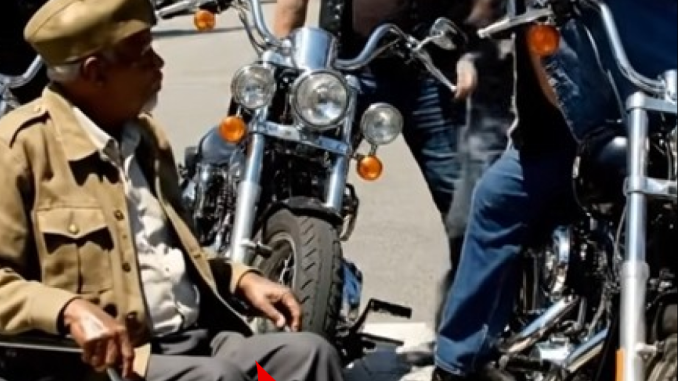
Respect is something most people assume is automatic. Yet sometimes, in ordinary moments, it is tested. What happened on a quiet afternoon at a neighborhood crosswalk became a powerful reminder that dignity is not measured by speed, strength, or appearance — but by character.
Mr. Williams, a 70-year-old veteran, was simply trying to cross the street in his wheelchair. The sun was bright, traffic was light, and a group of bikers stood gathered beside their motorcycles near the curb. They were laughing loudly, enjoying their afternoon, unaware that the next few minutes would shift the tone entirely.
As Mr. Williams rolled toward the crosswalk, one voice cut through the air.
“Hey, slow down! Old man, you don’t run this street!”
Another joined in. “The road isn’t going anywhere — why are you rushing?”
The words were loud. Some nearby pedestrians paused. A few people instinctively reached for their phones. It was one of those moments where tension can grow quickly.
Mr. Williams stopped his wheelchair and looked up calmly.
“I don’t need your permission to cross a public road,” he said firmly.
Instead of backing down, another biker stepped forward. “Look at you. You can barely move and you’re talking big.”
Then came a sharper comment: “Take that hat off. Nobody cares what you used to be.”
The hat in question was an old service cap. It wasn’t flashy. It wasn’t new. But it carried decades of history.
Mr. Williams didn’t raise his voice at first. He simply responded.
“I fought for these streets. For you to stand there yelling.”
The laughter faded slightly.
One biker challenged him again. “You think that cap makes you untouchable?”
Mr. Williams answered without hesitation. “No. It makes me earned.”
Those words landed differently. They weren’t shouted in anger — they were delivered with conviction.
“When people see what this stands for,” he continued, lightly tapping the emblem on his cap, “they stand with me.”
There was a pause. The atmosphere shifted. The bravado that filled the street moments earlier began to dissolve.
One biker lowered his voice. “Wait… he’s serious.”
Another nodded. “We crossed the line.”
The realization came quickly. What had started as teasing had turned into something disrespectful. And they knew it.
“That wasn’t right,” one admitted.
A biker stepped forward holding a coffee cup from a nearby café. “Sir, we owe you respect… and a coffee.”
The tension eased. Mr. Williams gave a small smile.
“It’s okay, son. People make mistakes.”
But the story didn’t end there.
As Mr. Williams began crossing the street, something unexpected happened. One by one, engines started — not aggressively, but deliberately. Nearly fifty bikers who had gathered nearby formed a slow escort around him. They didn’t rev loudly. They didn’t show off. They simply rode at walking speed, creating a protective path as he crossed safely and continued down the road.
What began as mockery turned into a gesture of solidarity.
Onlookers watched quietly. Some nodded. Others wiped away tears. The moment wasn’t about dominance or embarrassment. It was about accountability — and transformation.
Later, many described the scene as powerful. Not because of shouting. Not because of confrontation. But because respect was restored.
The veteran didn’t “win” through force. He didn’t demand applause. He simply reminded everyone that contribution does not expire with age — and service deserves acknowledgment.
In a world that moves fast, sometimes it takes one steady voice to slow everything down.
Respect isn’t about who speaks the loudest.
It’s about who has earned the right to stand tall — even while seated.